| Author | Message | ||
     april salem Advanced Member Username: April Post Number: 30 Registered: 08-2004 |
An interesting comment was made about charts and navigation rules. If a Ferry System has a certain form of rules, would or could this be on a chart? This is interesting as it surely makes sense. I will look for ATONs that might suggest such a thing, what a great idea! | ||
| april salem Advanced Member Username: April Post Number: 29 Registered: 08-2004 |
Mark, Re Bow watch and Mariners... if we are on the Spirit we do NOT put on a life jacket as we are not out on the bow sprit, we are IN the boat. The rim of the boat is up to my arm pits. We always put on harnesses when climbing the ratlines or hanging out on the bow sprit. Regarding being out AT NIGHT on bow watch with regular Sea Scout boats, yes, the kids do have life jackets. If they are on bow watch during the day, no they do not have life jackets on them but we have them on the rails or next to them. We have plenty of kids watching and they watch the watchers if that makes sense. We have never had a problem with youth! It is the adults who think they are invinceable. | ||
| Marc Hughston Moderator Username: Hughston Post Number: 197 Registered: 03-2003 |
UncleMark, I'm sorry to say you've got it wrong on the ferries. Just to make sure I wasn't missing something, I went down to the Sheriff's Harbor Patrol in Newport Beach. Officer J. Slikker says, no, the ferries are just powerboats and they give way to other powerboats on their starboard, vessels under sail, and may sometimes have to give way to the big party boats like the Entertainer, who can't stop on a dime. (And I say that's because of rule 9, not just because the partyboats are big) He said the ferryboat captains will sometimes tell you they have right of way so they're not inconvenienced, but they don't have any special rights. | ||
| Ted Lavino Senior Member Username: Tlavino Post Number: 227 Registered: 01-2004 |
Hello Mark, a couple of questions regarding your 6:46am post today (what were you doing up at 4am anyway?): 1. I didn't find mention of special treatment for the Balboa ferries on either the Newport harbor chart (18574) or in the Coast Pilot-could you give more info re: your source? Chapman's (if you want to use them as a reference) specifically indicates that ferries have no special priviledges, but references court decisions involving only ferries that are not very maneuverable, and only when they are leaving and entering their slips, that they are entiltled to a reasonable degree of freedom when entering and leaving their slips. (p.145 in the 63rd edition). 2. Regarding the 14ft. vessels having lines out in the middle of the channel, I would have to agree with Marc on this one. My read of the rules points to Rule 9 (impedance of vessels in a that can only navigate safetly in a channel), and if they don't recognize their responsibilities under Rule 9, then Rule 17 comes into play. My reading of the definition of a "vessel not under command" is one that "due to exceptional circumstance" (breakdown for example) is unable to avoid a collision, not one that is unwilling to maneuver (sitting back with a fishing pole in their hand), and therefore not relieved of responsibilities given in Rule 9. Here's the actual definition: "(f) The term "vessel not under command" means a vessel which through some exceptional circumstance is unable to maneuver as required by these Rules and is therefore unable to keep out of the way of another vessel." I don't think fishing in the middle of a busy channel with your engine off qualifies as not under command, but the end result is the same in that we end up giving way. - Marc | ||
| Mark Howe Moderator Username: Unclemark Post Number: 139 Registered: 08-2003 |
Off topic re April's last: Do Mariner Scouts wear safety harnesses when they are on bow watch.?? | ||
| april salem Advanced Member Username: April Post Number: 28 Registered: 08-2004 |
Marc I will work on my incredulous scowl and discontent look! Damn that means I can't get Botox! Yeah I too thought that I would stay out of the way of those things. Wow, aiming at them as if you will run them over? You must be fun to sail with!!! Can I do a hand thing like "mama mia whacha thinkin" Or Avast Scoundrel! I will be aboarding your ship and she is mine....or "move your bloomin arse as I am comin through and do a breast stroke on the bow of the ship (Ok I will put a life jacket on....) Well despite the negativity that some feel for Chapmans, I honestly like it for things like weather sailing and anchoring. It is simple, has plenty of pictures and it is written in a way that is logical. Now as I missed last class and the discussion regarding the clr (I believe that was it) I had better study up. I was at the base at 6pm last night and it was pitch black! We did have some ordinary rank go out for a cruise but it was gusty! We hang a kid off the bow with a flashlight for the nets. It works great! Well we don't hang them but we have definite "bow watch" on all the vessels. It is totally within regs to use a flashlight and scope the waters for such things as lobster traps and such. As I heard, many would rather have a light flashed than get rammed OR have their lobster traps messed up. When entering Avalon on Spirit we had several looking out for buoys, they are hard to see from so high up and when it is dark. A flashlight here and there combing the water did not bother anyone. It is harder to clean up in the dark though, so night sailing at the sea base is not as easy. I was an hour late getting home because the kids had to clean the boat and such. I assume we will be doing lots of class work? April | ||
| Mark Howe Moderator Username: Unclemark Post Number: 137 Registered: 08-2003 |
Regarding the veracity of Chapman's: This book is vetted constantly [used to be annually] so any discussions are the result of interpretations from actual court cases. As we so well know, we can't be sure of the interpretation of a rule until it has gone past a court [or magistrate at least]. The Coast Guard frequently uses this book to pass on their interpretations. They do this along with their civilian counterparts, the USCG Auxiliary and US Power Squadron who use it as their bible. | ||
| Mark Howe Moderator Username: Unclemark Post Number: 136 Registered: 08-2003 |
Had to get up at 0400 to catch up on this discussion. The Balboa Ferry system has the right of way; Susie got that. I believe it is printed on the chart as a special rule. As a kid sailing in the bay I recall being terrorized by the ferries, particularly when all three are in operation on a busy weekend. There is one pulling out at the island, another pulling out on the peninsula, and here comes the Joker right down on top of you in the middle. But they won't run you down. First, think about how much power they have to move all those cars as fast as they do; they don't have a weak reverse, they have a powerful forward in both directions. Second, look at the expression on the driver's face as he bears down on you; he thinks its fun to watch the expression on your face. Then, at the last minute he puts his engines in the opposite direction and the portion of the bay you are occupying moves sideways. Those engines are that powerful. Its not so much that he is stopping, he is just pushing you away. How to avoid a Balboa Ferry: As you approach the ferry lanes [just like the shipping lanes; special rules as Susie says]you pretend you are going to ram a ferry. As you get closer you pick the one that looks the most dangerous to you and decide on that one to ram. Then at the last moment you turn behind [if necessary] thinking you will pass within inches of his stern, but to your amazement, he is long gone by the time you get there. But the Commodore is right behind him so don't get complacent!!! 5 or more short blasts is the danger signal. Vessels in inland waters give signals to indicate their "intentions" [eg. passing on the left] and the other vessel either agrees [sends the same signal back] or disaggrees by by sounding the danger signal [usually more than 5 if danger is impending]. WE DON'T USE THESE SIGNALS. Imagine what it would be like in the harbor if boats did. Nobody would be able to tell who was tooting at who. We don't have turn signals, so we signal our intentions with our boat. That's why you make your turns early and gradually but definitely, so's the other guy knows what you're doing. Hand and arm signals also work, or body language, since you can see the driver and sometimes even the expression on his face!! BODY LANGUAGE IS OFTEN THE BEST SIGNAL! [practically speaking] Learn to use it. The fishing boat situation in Balboa Bay; they are a vessel "not under command" since they have no way to maneuver, but they are required to signal their condition to you under the rules. [recall my signal to you during our drills was hand over eyes] In this case, since it is so obvious, their condition would be considered signalled. But if you get close, their special signal is "Hey dude, kancha see I'm fishin' ?? " This signal must be sent with an incredulous scowl and a hint of outrage. | ||
| april salem Advanced Member Username: April Post Number: 27 Registered: 08-2004 |
I have a good idea! Just about everyone who drives a boat has driven a car...mostly anyway. So what we need are turn signals! Yeah, how about if we had red and green flashing blinking lights in the front which indicated where we intended to go? Just about everyone knows what that means... so if you were in international waters or where ever they would know that if you were on a collision course you could turn on your green and both go port to port... and then maybe we could have a flashing yellow which meant caution... like our stop lights! I surely doubt that most people out there remember all their rules of the road and they could just fall back on drivers ed! <smile> Well we would need a straight ahead color....purple? Hey sounds good to me! A few flashlights with different colored lights and voila! What say ye? Lets rewrite the rules! Sylvia? I know you would be up for it! | ||
| april salem Advanced Member Username: April Post Number: 26 Registered: 08-2004 |
Marc, I still have not had any practice with Ferry boats, I think that if I heard 5 blasts come back at me from one I would probably hope they were monitoring a channel where I could contact them and find out what was going on, if they were "strongly disagreeing" and I didn't know what was happening, I am certain that I would not zoom around them anyway. I think the sailor who said "oh no you can't" was aggrivated over his experiences of Puget Sound. I would imagine their Ferries are quite large and probably not easy to see around. The sites I visted were sites made by sailors who were bitching about Ferry Boats and such. I figured this was a good place to get their side of the story! So the Ferry boats in Newport California actualy WILL stop and let a sailboat pass? When I have been a passenger on them they didn't seem to notice what was going on in the channel, they were communicating more with the other side so they could dock... again I was a pedestrian passenger and they seemed to be run by guys who were quick and concerned about not hitting the other crossing Ferry as they passed each other. they didn't seem to care what was in the channel.... it was all about getting those cars over and stopping the back up that trailed out into the streets. I am glad I do have to do that course! I will be ready though...just in case! And I will be ready to duck and correct! | ||
| Ted Lavino Senior Member Username: Tlavino Post Number: 226 Registered: 01-2004 |
Thanks for the save Marc-also great explanations! For those of you who are wondering, my fingers were getting a bit ahead of my brain in the last paragraph of my 10:10pm post last night. What I meant to say was that the ferry (not the sailboat propelled by machinery which you were on) was the give-way veessel. Also, ometimes vessels do not follow the rules (for whatever reason), and rather than standing on until a collision happens, Per Rule 17 you should take whatever action is necessary to avoid the collision when the give way vessel is not giving way. http://www.navcen.uscg.gov/mwv/navrules/Rules/Rule1617.htm I also mentioned to April local custom that while not changing your legal responsibilities, should be followed unless circumstances do not permit. For example, Rule 34g and 34e stipulates that all power vessels shall exhibit a prolonged blast on their whistle (Navigation Rules-ese for horn) whenever leaving their berth and all vessels (sail and power) shall exhibit a prolonged blast when coming to an area where your view of other vessels ahead is obstructed. So when you back out of your slip, according to the rules you are to let loose with a 5 second blast with your horn. And when you get to the end of your fairway and joining the channel, you are to again let loose with another 5 second blast if you cannot see around the other vessels in their slips. You are well within the rules to do so, but you will certainly not be popular with your neighbors! Another example is day shapes. Per Rule 25, any sailing vessel over 12 meters (about 40ft) must exhibit a cone day shape when underway being propelled by machinery. I have yet to see a sailing vessel in this area exhibit the legally required day shape, and certainly have not heard vessels giving the legally sounds when departing their slips. So one must also take into consideration local customs as well as the rules themselves. | ||
| Marc Hughston Moderator Username: Hughston Post Number: 196 Registered: 03-2003 |
Additional Clarification: Regarding ferries The ferries in Newport are crossing a narrow channel (the Balboa Reach), and therefore have more special obligations (Rule 9). Being under 20 meters, they may not impede vessels that can only safely navigate within that narrow channel. Susie got this 90% right in here earlier post. The distinction is whether a vessel can only safely navigate within the narrow channel – not whether a vessel is using the channel. So, which are the boats that can only safely navigate within that narrow channel? The Coast Guard has informed the party boat operators that they operate under rule 9. So when you see one of those party boats over 20 meters in the channel, just know that they won’t be giving way to you whether you are under sail, or you are power boat on their starboard. So in this case, the crossing ferries must give way to vessels under sail, the party boats, and power boats on their starboard. They stand on when power boats are on their port. Other ferries elsewhere might be within a narrow channel that they must stay in to safely navigate, and that fact would obligate other vessel crossing the channel to keep clear of them – but not because they are ferries, because they are operating under rule 9. Regarding Big Boats Big boats do not have right of way because they are big. There is no Gross Tonnage Rule (even though Chapman's refers to it). When crossing, meeting, and overtaking, refer to the pecking order. It’s a mistake to give way to a big boat when you are actually the stand – on vessel. This can put you right back on a collision course, as Ted and April noticed. Freighters in the open ocean must give way to sailing vessels, even small ones, and I’ve had that happen on passage from Santa Barbara Island to Anacapa. Re April’s mention of 5 blasts That actually means doubt or disagreement, and is not a command such as “No you can’t”. As Ted has said, it is far better to take a look at the actual rules of the road. | ||
| Marc Hughston Moderator Username: Hughston Post Number: 195 Registered: 03-2003 |
Wow – good discussion! There are some things you guys have stated, based on your research, that I need to correct. But first, let’s tackle the scenario’s one by one. “1. We are sailing down the channel on starboard tack, engine off. A car ferry pulls out from Balboa Island on our port bow and is crossing, with a constant bearing and decreasing range. Do we give way or stand on?” We stand on. This is strictly a sail vs. power vessel crossing situation. However, I have had to duck on a couple of occasions when I realized the ferry was not taking appropriate action to avoid me. ”2. We are motorsailing up the channel, and this time the Balboa Island ferry is on a collision course, crossing over from our starboard bow. Do we give way or stand on?” We give way. This is a power vs. power vessel crossing, and we must give way to vessels to starboard. ”3. We are tacking out the channel toward the ocean, and one of those little 14 foot skiffs is adrift in the middle of the channel, and three guys have fishing poles out with lines over the side. Their engine is off, but they are not anchored, and we will collide with them unless one of us gives way. Do we give way or stand on?” We are the stand on vessel, (sail vs. power driven vessel underway) but I’ve never once seen any of the fisherman lift a finger to move. When several hundred feet from the skiff, if I don’t see any activity indicating they are going to move, I change course early, and significantly to avoid them. So in this case, I’m following the rules by altering course (and not standing on as the rules otherwise require) when I see the other vessel is not taking appropriate action. | ||
| april salem Advanced Member Username: April Post Number: 25 Registered: 08-2004 |
Ted, That could be, I know Chapmans is old, it has great stuff on anchoring though and wind and weather. Some of the practical sailing is still the same. I really like it. As far as rules, again I think that they still all say that nothing in in stone and that in all situations we will be in the wrong if we do not avoid a collision when we can, even if the "wrong" is just damage to our own crew and vessel. I did a search on google to see what areas who used Ferry's in different locations did with regard to sailing. This seemed the most appropriate thing to do because I don't practice around them. Everyone and I really do mean all the sites that have complaints about them, all said that they give them special treatment. In fact it is said that if one wants to overtake one, in areas of Seattle the Ferry boat can send back 5 blasts and say NO YOU CAN'T I am lucky that I have not had to deal with them, I would never want to deal with them in a court of law! I can see it.. well I was the stand on vessel... yeah I could easily see the Ferry, yeah, it sure did look as if it had a definite intention, no I knew I was supposed to igrnore that intention because the rule book says that I was on the right and have the stand on authority, so why did I crash and hit it? Well the book says....... I think that knowing how these things work, how fast they actually go, and how well I can maneuver my own vessel is really what counts. From what I have read most sailors will give them special consideration, perhaps that comes out of courtesy. The rules about boats only working in harbors had to do with small craft, vessels that only crossed channels and did not go up and down them, perhaps inland vessel assists or something, I don't know. I could not find a definite "rule" per say regarding them but that does not surprise me. I don't think anyone wants a "rule" or they would be like a stop light in the middle of the channel! We would have to wait for the light to turn green before we crosed! LOL We could have rush hour traffic! They might even get bossy and take extra time loading and that could count if they had intention etc... so I hope that a definite rule won't jump out, the sailors oath to be courteous and save their ship and crew should be sufficient! Aye, the little ferries can have their fun, we get the wide open sea! | ||
| Susie Campbell Senior Member Username: Susie Post Number: 103 Registered: 10-2002 |
Some people are given special treatment and so are some boats. For example: The instructors in our classroom have a nice little bathroom that they can use at anytime. The instuctors are people, created equal, just like us studendts but they are SPECIAL beacuae they serve an important purpose. They teach us. Most students don't even know that this bathroom exists and that the instuctors can use it at any time. I think the Ferry, like our instuctors, is SPECIAL. It too, serves and important service and because of it, has priviledges that we are unaware of. Think about it...it goes from one dock to the other, all day long. I don't think it goes anywhere else, it just doesn it's job. It's SPECIAL...there has to be a special rule that we are unaware of. As for the fishermen...I say just stay out of their way. They shouldn't be there but if you don't avoid a crash, you're the one who will be at fault for not taking proper action to avoid a collision. | ||
| Ted Lavino Senior Member Username: Tlavino Post Number: 225 Registered: 01-2004 |
Hi April, when discussing the Navigation Rules, one must be careful of treating an opinion as fact or law. Chapman's is indeed a fine publication, but it has no authority when discussing Navigation Rules, so one needs to take whatever is printed with a grain of salt and validate it against the actual Rules, which is why I continually refer back to official copies of the Rules themselves in my posts. While there are interperetations in various courts as to the exact meaning of the rules, for the most part the authors have taken great pains to make them self explanatory. As far as I can tell there are no mentions of ferries spefically in the Rules, and therefore they are granted no special treatment. Also as far as I can tell there is no special treatment regarding vessels that can only be used in channels, as you describe. There is mention however of special treatement when a vessel is navigating a channel and is required to do so due to draft for example (Rule 9). I think you might be thinking of the part of Rule 9 that has to do with navigation within a river system... | ||
| april salem Advanced Member Username: April Post Number: 24 Registered: 08-2004 |
Ted, I was given an old Chapman's Piloting Seamanship and it states that inland water rules are very important with regard to vessels that are ONLY used in channels. This would mean that the ferrys actually do have a stand on position. I do not know if this law was changed as Chapman is rather old but it definitly states that vessels which can only operate in harbors and channels have particular rights. Often they are not equiped to maneuver or have the same power as ocean going boats. The rules to Ferry boats according to Chapman are that they have no express provision of particular rules however the courts rule that they are entitled to reasonable freedom due to their maneuverablity. When I did a Google search online all sites stated that Ferry Boats came under the heading of those boats in narrow areas with limited ability to maneuver. One site stated that if the boat is a lot bigger than yours it has the right of way! He mentioned this in terms of the weight and such of Ferry boats. So it would appear that according to Chapmans, according to both the areas outside of Seattle and the inland Ferry's of the East Coast, that they have "particular consideration due" to lack of maneuverability. I would just want to save my boat and my crew! And I would not want to bump off the tipsy folks off the Ferry boat! <smile> | ||
| Ted Lavino Senior Member Username: Tlavino Post Number: 224 Registered: 01-2004 |
An interesting couple of articles in Ocean Navigator on the subject of crossings: http://www.oceannavigator.com/site/csrv/content.asp?id=1544 http://www.oceannavigator.com/site/csrv/content.asp?id=1551 | ||
| Ted Lavino Senior Member Username: Tlavino Post Number: 223 Registered: 01-2004 |
Actually, in further reading of your last post, another important rule is brought up in terms of your question of a vessel's speed and being able to stop and/or maneuver to avoid other traffic-Rule 6, which is VERY important when maneuvering in a crowded marina or channel: http://www.navcen.uscg.gov/mwv/navrules/rules/Rule06.htm As you can see, a particular circumstance may have several rules that apply and govern behavior... | ||
| Ted Lavino Senior Member Username: Tlavino Post Number: 222 Registered: 01-2004 |
I think that's the discussion about which Marc was trying to generate. I was actually using your example of turning to port to go behind the ferry to illustate another rule that might apply in that specific situation. By the book the ferry to port of the sailboat under power is the stand on vessel. But sometimes rules don't work as well as we would like in the real world amd sometimes local practices come into play as well. I look forward to Marc's comments. | ||
| april salem Advanced Member Username: April Post Number: 23 Registered: 08-2004 |
Ted, If two power boats were in a collision course would they not just let the guy on the right go or end up going port to port if they made a mistake? When thinking of the "big fat Ferry" and a sailboat under power, I know that the sailboat "should" have the right of way if it is on the right but if they are both on a collision course can the "big fat Ferry" (I know it sounds horrible) truly stop or slow down enough to let the sailboat through? I do understand the person on the right has the stand on state but I just do not know about Ferrys. And big fat ones with cars and such could have trouble maneuvering. What is the answer with Ferry boats? | ||
| Ted Lavino Senior Member Username: Tlavino Post Number: 221 Registered: 01-2004 |
BTW, my teaser should have referenced rule 17c, not 17a... Sorry for the confusion. | ||
| Ted Lavino Senior Member Username: Tlavino Post Number: 220 Registered: 01-2004 |
Well, think of the scenario this way: 2 vessels, both propelled by machinery, meet in a crossing scenario and a risk of collision exists. Vessel A is on the left, Vessel B is on the right. Vessel A realizes that a risk of collision exists and that they are the give way vessel and alters course to starboard to go astern of Vessel B. Vessel B doesn't believe that Vessel A is taking appropriate evasive action and turns to port to go astern of vessel A. Now both vessels have turned toward each other, increasing the risk of collision. Repeat this scenario a few times and you can imagine the result. Hence Rule 17c. | ||
| april salem Advanced Member Username: April Post Number: 22 Registered: 08-2004 |
Ted: One more teaser: Switch from sail to power in scenario #1 (coming up the channel and you see a ferry from Balboa on a collision course from your port side), and use April's suggestion as to how to handle the situation, keeping in mind Rule 17a. Now what do you do? EEEEK, how many horsepower do I have? Will I cause a wake? Are any of the passengers on the Ferry inebriated? Are any of MY passengers inebriated and do they have life vests on? Have I had several cups of coffee? Is it MY boat? (I do not have a boat but if I had one, I would be kind to her) I still think that Ferry boats are incapacitated to a certain extent. It is like one of those computer games...I gotta jump to the other side, and yet, I know that pendulum will keep going back and forth because that is its job. So what do I do? I know it will do its job. I think I will err on safety and get over quickly after it passes! I won't wait for it to start over and zoom in front of it! | ||
| april salem Advanced Member Username: April Post Number: 21 Registered: 08-2004 |
"Comments to further the discussion:" Have you ever seen the ferries displaying the day shapes that are required for a vessel restricted in her ability to maneuver (ball, diamond, ball)? Is the ferry really any more than a power driven vessel? Well I have been on them and they sure seem to be more than a power driven vessel, they have cars, bikes and people all under the influence of something...(no I wasn't...yet) Those folks could fall over the edge if a sudden move was needed! Now I assume that the drivers are amazingly competetent, but still if it was MY boat and I knew that ferry could give a rats ass about it, I would want to save her! If the obligation of the stand-on vessel is to maintain course and speed, is she breaking the rules when she ducks, or corrects her course as a courtesy? I think that courtesy comes with the ability of the other boat to react. If indeed I can expect that they will put their beer down, pull in some lines, or do a 360 with several cars on board, I will stand on... if I cannot be sure, I will err on the side of safety and perhaps making the sound of which side I was attempting to pass would be the best action. One for port and two for starboard. Now that picture was wild! I asked my kids and they said well certainly you would want to stay to the starboard side as it was green but who knew how far to the side that thing "grew". I suppose in this action I would want to clarify what the Hell that thing was. I would hope that they were monitoring 16 and I would ASK! "Thing with the three lights, Thing with the three lights, This is April to your port, what the Hell are you over?" (I would promptly tell them to switch to channel 71 or such and discuss the best way to get around them!) Heck I am not so sure that I would chance my boat and my crew for my ego and thoughts that I "knew" what it was if I didn't! I could not see diamonds in the dark! Oh please Marc, are there going to be trick questions? Can I do a channel 16 to you in class if I am not sure what the Hell you mean and your intent? Ahhhhhhh! Basically what would YOU do in those channel questions? Would you stand on and expect that the Ferry would speed up or go around you, would you alter your course just a touch so that you would head for their stern? I just don't know the exact answer even though I know what I would "knee jerk" want to do! My thoughts are to have a safe sail and be prepared for anything and correct as needed. I don't think that I would be in the wrong if I corrected and everyone was happy. If the other vessel was capable then my correcting could cause trouble. I think that is the real question and I have zero experience with Ferry Boats. Can you give me a hint? | ||
| Ted Lavino Senior Member Username: Tlavino Post Number: 219 Registered: 01-2004 |
For those pondering Marc's ferry and skiff questions, some additional things to think about: Do inland or international rules apply in these instances? Why? See: http://www.navcen.uscg.gov/mwv/regulations/33CFR080/33CFR80_Gen.htm and http://chartmaker.ncd.noaa.gov/nsd/Cp7/CP7-36ed-Ch02_7.pdf starting at paragraph 493 and in this case particularly paragraph 501. What kind of communications need to be going on between vessels in these situations? Check out Rule 34, particularly the section regarding agreements, and what should happen if there is no agreement reached, or there is doubt as to the agreement reached. One more teaser: Switch from sail to power in scenario #1 (coming up the channel and you see a ferry from Balboa on a collision course from your port side), and use April's suggestion as to how to handle the situation, keeping in mind Rule 17a. Now what do you do? | ||
| Marc Hughston Moderator Username: Hughston Post Number: 194 Registered: 03-2003 |
Here's another item for discussion. Suppose you are exiting the Ventura Harbor at night and you see these lights.  What are you looking at, and which side should you pass on? The two green lights indicate the safe side to pass on, and the two red indicate the danger side. Check out the image below to see what this contraption really is.  This is a very clear illustration of what Restricted Ability to Manuever means - restricted by the nature of her work, and she shows the day shapes that mean just that. And, you couldn't pass on the left hand side even if you really wanted to. 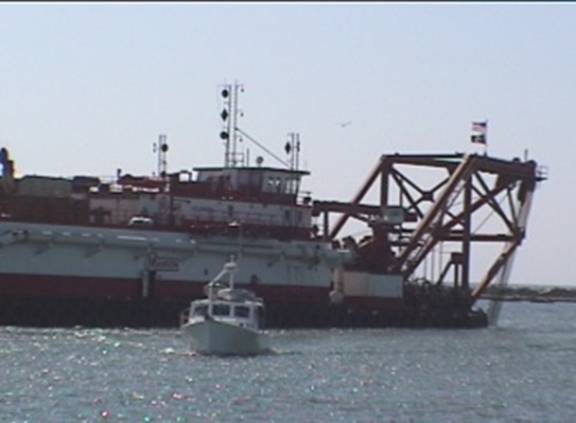 | ||
| Marc Hughston Moderator Username: Hughston Post Number: 193 Registered: 03-2003 |
Comments to further the discussion: Have you ever seen the ferries displaying the day shapes that are required for a vessel restricted in her ability to maneuver (ball, diamond, ball)? Is the ferry really any more than a power driven vessel? If the obligation of the stand-on vessel is to maintain course and speed, is she breaking the rules when she ducks, or corrects her course as a courtesy? Since the skiff is a power driven vessel underway (though not "making way") is she required to fire up the outboard and move to avoid us? "Hey Joe, fire up the outboard man. No, leave the choke in! Pull! Pull! Put that beer down and PULL! Hey what are you guys doin' I've got a fish on the line??!!! Ahhhh!!!!" | ||
| Susie Campbell Senior Member Username: Susie Post Number: 102 Registered: 10-2002 |
Yikes...the Balboa Ferry is transferring materials. (cars) hum....maybe this would be a RAM. I found this under Part A-General Rule 3 General definitions; Exampls of RAM are bouy tending, laying cable, dredging, surveying, diving, TRANSFERING MATERIALS, launching or recovering aircraft, minesweeping, towing. transferring materials means between ships - like when the fishing vessel comes along side and transfers a few hundred pounds of lobster...And I would add that the in the ferries' work they exhibit exceptional manueverability | ||
| Susie Campbell Senior Member Username: Susie Post Number: 101 Registered: 10-2002 |
Question...Is the ferry restricted in her ability to maneuver? (RAM)The definition for RAM is: A vessel which due to the nature of her work, cannot maneuver easily. I think that the Balboa Island ferry can maneuver easier than a sailboat so my guess would be she's not under the RAM qualifications. | ||
| april salem Intermediate Member Username: April Post Number: 20 Registered: 08-2004 |
Marc, "1. We are sailing down the channel on starboard tack, engine off. A car ferry pulls out from Balboa Island on our port bow and is crossing, with a constant bearing and decreasing range. Do we give way or stand on?" Wow, that would surely scare me. In all "regs" it would appear that I am a stand on vessel but with safety in mind and the fact that they do not reverse quickly, or speed up fast, I would give way, correct my course to their stern and hope for the best! 2. "We are motorsailing up the channel, and this time the Balboa Island ferry is on a collision course, crossing over from our starboard bow. Do we give way or stand on?" Again I think that the problem of being able to correct is the issue, they have limited ability and if there is a collision course, I would not want to chance it. Again I would aim for their stern and correct. I have not had to work in a channel under those conditions, are their many accidents? Surely there must be! I have not seen or heard of any accidents, and based on what I see others do I think they must be rare. It's a very busy place on the weekend though. 3. "We are tacking out the channel toward the ocean, and one of those little 14 foot skiffs is adrift in the middle of the channel, and three guys have fishing poles out with lines over the side. Their engine is off, but they are not anchored, and we will collide with them unless one of us gives way. Do we give way or stand on?" I would correct, (not stand on) and avoid them! It seems to be a courtesy issue here, it would be very hard to have them put their gear up and away and move and adjust. Hooks could fly! So I would stay out of their way. It seems to me that if the other vessel would have a difficult time changing course, then I do not worry that we would be on a "let me change-no I vs. you will change" deal where changing my course would make it worse. I would stand on if it helped to clarify what my intent and their position "should be" when it would work for the both of us. If they have to bust butt to keep from collision and I only have to change course and keep on sailing then that is what I would choose. I think that the position of courtesy vs absolute rule, is important. And still I can see that if I was wishy washy when both vessels had control, I would cause trouble if I did not understand basic sailing rules of the road. It falls into place. When on the Spirit, we had to have bow watch at all times because our reaction time was not fast. Also the "con", man in control, of the vessel could not see easily so far above the water and behind two masts. We passed some huge freighter that I thought was very far away... but we passed him at about 200 feet which is not far with big vessels... he was under power but still we were very careful! We also saw the Argus at Catalina... We could see her from far away as she approached. It was interesting sailing on such a large vessel in the dark! And again we needed far more wind to get speed to change tack and course. There was not a lot of wind so this also put us at some disadvantage. It was a good sail when using what I have learned, also to err in favor of safety was a good lesson. We put our anchor light up as we were anchoring so that all could see our intent. They could surely hear it! Those chains are so loud.. do not sleep in the "fo'c'sle". It is worse than Haunted Mansion with the sound turned up high! | ||
| Susie Campbell Senior Member Username: Susie Post Number: 99 Registered: 10-2002 |
This is a narrow channel and I think that the ferry is under 20 meters. Does the ferry have any special rights? If not, I think rule 9 says it all. If crossing a narrow channel, don't impede vessels using the channel. If sailing, fishing, or less then 20 meters in length, don't impede a vessel using the channel. If overtaking, first obtain agreement by sound signals. Otherwise, get over to the starboard edge of the channel! So...in all three of these situations, I'd say you have the right to "stand on" until you clearly see that these guys are not following the rules or don't know them. If you do change your course, make it positive and quick. You may even have to reduce your speed or even go into reverse to miss hitting these guys. In the third situation the guys fishing are not by definition of the "rules of the road" Fishing. Definition of a vessel ingaged in fishing is: Vessel fishing with equipment that restricts the maneuverability (nets, trawls, etc) This does not include fishing boats when not fishing, nor angling or trolling recreational boats. | ||
| Marc Hughston Moderator Username: Hughston Post Number: 191 Registered: 03-2003 |
And now for some more discussion. Here are some situations that I am confronted with most every weekend in the Newport Harbor. Who would you say is the stand-on vessel, according to the rules? 1. We are sailing down the channel on starboard tack, engine off. A car ferry pulls out from Balboa Island on our port bow and is crossing, with a constant bearing and decreasing range. Do we give way or stand on? 2. We are motorsailing up the channel, and this time the Balboa Island ferry is on a collision course, crossing over from our starboard bow. Do we give way or stand on? 3. We are tacking out the channel toward the ocean, and one of those little 14 foot skiffs is adrift in the middle of the channel, and three guys have fishing poles out with lines over the side. Their engine is off, but they are not anchored, and we will collide with them unless one of us gives way. Do we give way or stand on? | ||
| Marc Hughston Moderator Username: Hughston Post Number: 190 Registered: 03-2003 |
The following is a memory aid for the pecking order between vessels when there is risk of collision - we covered this in the last class. Our Navy Requires Canned Fish Served Promptly at Seven When laid our vertically, vessels below must give way to those above. Our-------O--Overtaken Navy------N--Not under command Requires---R--Restricted manueverability Canned----C--Constrained by draft Fish-------F--Fishing (engaged in fishing as defined by rules - not trolling) Served----S--Sailing Promptly---P--Power at Seven-----S--Seaplanes | ||
| Ted Lavino Senior Member Username: Tlavino Post Number: 214 Registered: 01-2004 |
Greetings All, during class I hear the term "right of way" thrown about when discussing the Navigation Rules (rules of the road). I thought this might be a good place to paste an exceprt from the USCG NavCenter on the topic: he International Navigation Rules do not confer upon any vessel the "right of way" however, certain vessels "in sight of each other" are responsible "to keep out of the way" of others. Usually, power-driven vessels are to keep out of the way of a vessel "not under command or restricted in her ability to maneuver", sailing vessels or a "vessel engaged in fishing". However, some exceptions exist when they themselves "are not in command" or "restricted in her ability to maneuver" (Rule 18), overtaking another vessel (Rule 13), are navigating a "narrow channel or fairway" (Rule 9), and other less explicit circumstances. Navigation Rules should be regarded as a "code of conduct" and not a "bill of rights". They do not bestow rights or privileges, but impose the duty to either "give-way" or "stand-on", dependent on the circumstances. What is important is not so much what things are, i.e. sailing vessel, operational, etc., but how to avoid collisions, e.g. although under sail yet able to be propelled by machinery, obtaining an early warning by radar, etc. Understand, the Rules are in place to "prevent collisions" not to define nautical terms or to be subjected to strict interpretation. The Inland Navigation Rules convey the "right of way" under limited circumstances in Rule 9(a)(ii) which states: Notwithstanding paragraph (a)(i) and Rule 14(a), a power-driven vessel operating in narrow channels or fairways on the Great Lakes, Western Rivers, or waters specified by the Secretary , and proceeding downbound with a following current shall have the right-of-way over an upbound vessel, shall propose the manner and place of passage, and shall initiate the maneuvering signals prescribed by Rule 34(a)(i), as appropriate. The vessel proceeding upbound against the current shall hold as necessary to permit safe passing. From time to time the Coast Guard may restrict persons or vessels from entering a Security or Safety Zone, however, this does not confer a "right of way" to vessels within the zone. These Zones are established to limit access to an area "described by fixed limits or it may be described as a zone around a vessel in motion" which may "be necessary to prevent damage or injury to any vessel or waterfront facility, to safeguard ports, harbors, territories, or waters of the United States or to secure the observance of the rights and obligations of the United States". Finally, all this said, the ordinary practice of seamen requires precaution under all conditions and circumstances and not strict adherence to the rules or any other practice. Although strict adherence may not always be prudent, the Rules are very precise in stating that nothing "shall exonerate any vessel, or the owner, master or crew thereof, from the consequences of any neglect" (Rule 2). Neglect, among other things, could be not maintaining a proper look-out (Rule 5), use of improper speed (Rule 6), not taking the appropriate actions to determine and avoid collision (Rules 7 & 8) or completely ignoring your responsibilities under the Rules. So in reality there is no "right of way", only "stand-on" and "give-way" vessels. T. | ||
| Ted Lavino Senior Member Username: Tlavino Post Number: 213 Registered: 01-2004 |
Greetings All, in response to April's question regarding fishing vessels and vessels at anchor in the main thread in this section: The best way to answer this is to see what exactly the Navigation Rules say (see my previous post for a link to them). Rule 3d defines vessels engaged in fishing: "The term "vessel engaged in fishing" means any vessel fishing with nets, lines, trawls, or other fishing apparatus which restrict maneuverability, but does not include a vessel fishing with trolling lines or other fishing apparatus which do not restrict maneuverability." Therefore a fishing boat merely trolling or drifting with a couple of lines led aft does not fall under this definition and therefore does not have special treatment. Both vessels under sail and vessels under power are the give way vessle when it comes to vessels that meet the criteria for "vessels engaged in fishing" above. In that case, according to Rule 18: Except where Rules 9, 10, and 13 otherwise require: (a) A power-driven vessel underway shall keep out of the way of: 1. a vessel not under command; 2. a vessel restricted in her ability to maneuver; 3. a vessel engaged in fishing; 4. a sailing vessel. (b) A sailing vessel underway shall keep out of the way of: 1. a vessel not under command; 2. a vessel restricted in her ability to maneuver; 3. a vessel engaged in fishing. (c) A vessel engaged in fishing when underway shall, so far as possible, keep out of the way of: 1. a vessel not under command; 2. a vessel restricted in her ability to maneuver. (d) 1. Any vessel other than a vessel not under command or a vessel restricted in her ability to maneuver shall, if the circumstances of the case admit, avoid impeding the safe passage of a vessel constrained by her draft, exhibiting the signals in Rule 28. 2. A vessel constrained by her draft shall navigate with particular caution having full regard to her special condition. [Intl] Note that the rules above refer to sailboats and power boats that are under way, which is defined in Rule 3 as: "(i/h) The word "underway" means that a vessel is not at anchor, or made fast to the shore, or aground." Also: "(f) The term "vessel not under command" means a vessel which through some exceptional circumstance is unable to maneuver as required by these Rules and is therefore unable to keep out of the way of another vessel." Note that the definition of "not under command" refers to "exceptional circumstances", such as a failure of the steering system. It does not include for example a vessel on which the helmsman went below for a cup of coffee. So a power or sailboat at anchor is not "underway" and therefore is not a burdened vessels in the circumstances descibed by the rules above, but I don't recall how the rules treat specifically treat vessels at anchor. Marc, could you jump in here? | ||
| Ted Lavino Senior Member Username: Tlavino Post Number: 212 Registered: 01-2004 |
Greetings All, somehow I neglected a most important resource-the online version of the Navigation Rules (Rules of the Road). For your continued enjoyment: http://www.navcen.uscg.gov/mwv/navrules/navrules.htm Some other great resoources like the Chart #1 we discussed last Friday which describes the meaning of all items you might find on a chart and USCG Light List that lists the characterstics of all lights in US navigable waters are also available at: http://pollux.nss.nima.mil/pubs/ T. | ||
| Ted Lavino Senior Member Username: Tlavino Post Number: 209 Registered: 01-2004 |
There was also discussion regarding Colreg Demarcation lines that appear on charts. These designate where Navigation Rules switch from Inland to International and vice-versa. Usually they exist accross harbor and bay entrances where the normal rules of delineation do not work or are not clear. Further information on ColReg Demarcation Lines can be found in the U.S. Coast Pilot Vol. 7 Ch. 2 Section 80.01 (paragraphs 493-494) (http://chartmaker.ncd.noaa.gov/nsd/coastpilot7.htm). Dana Point's ColReg Demarc line information can be found in section 80.1110 (paragraph 500). Regarding Mark's remarks on the requirement for vessels in Avalon harbor to employ sound signals required by Rule 35, see section 80.1102 (paragraph 496), which specifically states that International Rules apply to all harbors on Santa Catalina island, and therefore all vessels 20 meters and below are required to sound their bells every 2 minutes-what a racket! As Mark indicated that rule thankfully does not seem to be enforced, but it is there in black and white... Thought you might want to know...  | ||
| Ted Lavino Senior Member Username: Tlavino Post Number: 208 Registered: 01-2004 |
I must have been half asleep when I posted the above. What I was trying to point out was that vessels anchored in Inland waters in a Desginated Anchorage" do not need to sound the signals described in Rule 35, nor are they required to exhibit lights or day shapes required in Rule 30. Authoritative information on this topic is the link I gave in my previous message. Information regarding Designated anchorages may be found in the U.S. Coast Pilot Vol. 7 in Chapter 2 Part 110.1, which is paragraphs #555-556. Specific information regarding the designated anchorages in Dana point is in Part 110.93, which starts at paragraph 628. There is a designated anchorage off of the Marine Insitute. It is shown on the NOS Dana Point harbor chart via graphic referenced to as Note A. Avalon is NOT a designated anchorage, nor is it in Inland waters, so the exemption to required sounds lights does not apply (see the next post). Cheers | ||
| Ted Lavino Senior Member Username: Tlavino Post Number: 207 Registered: 01-2004 |
Greetings All, I know all of you are losing sleep over the discussion regarding the requirements for vessels at anchor in fog. Well the USCG is there once again to help you out of your misery. Per the November, 2003 revisions to both inland and international rules, vessels of less than 20 meters are not required to ring their bells every minute. They can do something else ("an efficient sound signal") every two minutes instead. Says so in the manual: http://www.navcen.uscg.gov/mwv/mwv_files/NR_Files/Insert_page122.pdf Sleep well! | ||
| Ted Lavino Senior Member Username: Tlavino Post Number: 217 Registered: 01-2004 |
Right you are Susie! One correction though-the vessel that the stand on vessel in a narrow channel must be restricted in navigation to that narrow channel, for example by its draft or maneuverability. Specifics can be found in Rule 9: http://www.navcen.uscg.gov/mwv/navrules/rules/Rule09.htm | ||
| Susie Campbell Senior Member Username: Susie Post Number: 98 Registered: 10-2002 |
April; The definetion for vessel engaged in fishing is: A vessel fishing with equipment that restricts maneuverability. This does not include fishing boats when not fishing, or people fishing with just a hook and line or trolling. At night...you may see a fishing vessel with a red over white light or a trawler with a green over white light. If you see another white light off to the side it means they have gear extending out 150 meters. This would tell me that their RAM and that I should stay out of their way. Fishing, sailing, crossing and vessels under 20 meters may not impede the passage of ANY vessel in a narrow channel. Someone correct me if I'm wrong! Susie | ||
| april salem Intermediate Member Username: April Post Number: 18 Registered: 08-2004 |
Marc! Holy Cowski! I actually understand this? Thanks Ted for drilling us when we were out there! YAY! Damn I actually get it, or did get it, lets hope it stays in my noggin! I promise I will practice practice and practice! You know, I do have a question regarind rules of the road, in some texts I have read that only commercial fishing boats have any "special rights" over sail boats, and that if you just throw your pole out there and are sitting around under power that you have no rights. Is this because under power comes into play? What if a power boat is anchored, then they are an anchored boat and we avoid them, right? Or what if a power boat is just floating around and fishing...they are off of power so they are a burdoned boat? I just hear things about fishing boats and some texts say only commercial fishing boats get right of way, so sometimes it is confusing. I would always err on the safety side as who wants to be near fishing lines... I will be on time! I will be at the docks at 5:30 or just before if you like. I went to get a part for "a jib" for Jim today and figured that since it was a part for a jib I would take my small car...well it was a spar and furling rig! I had to put it out my windows like a jousting pole! LOL They tied it up so it would not fly out of my car but it was a great way to have "right of way" along PCH!!!! |

