|
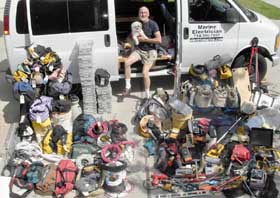
I've included a few photos for possible future entries. Perhaps you can guess what the article will be about. |
|
|
|
|
Restore AC power quickly if your inverter bricks. So that the
inverter can automatically pick up supplying 120 VAC when shore power cuts
out, shore power loops through the inverter. The transfer relay is
in the inverter in anything built in 20 years. Inverters are pretty
reliable. When yours fails you will ................................
|
|
Appearance vs. FunctionalityOccasionally I am called in to fix a problem with another person's work. Usually the workmanship looks good but the circuit is hooked up wrong. Sometimes the wiring is actually quite pretty, all 90 degree bends and tie wraps every few inches. I call this "knowing what it should look like rather than understanding how it works." begun 6/30/06. in progress. . . |
|
http://www.electricmarine.com/weblog/article/14/in-praise-of-ventilation-and-the-weep-hole |
|
Dielectric Greasetransferred to the new site |
|
Cut Hands in Salt Water (ouch), What to Do?On a trip to Santa Cruz Island in 2001, I was privileged to dive into what is known around here as Emerald Cave. This underwater cave traps a decent bubble of air so you can free-dive from another sea cave and breathe once inside. The water in a long submerged passage to the sea filters daylight to a soft emerald green glow. Really quite pretty. It's also known as Blood Cave because its surfaces are just a little less sharp and jagged than broken glass. Someone gets bloodied every trip. Not wearing gloves, I got several fairly serious cuts on my hands. Bad enough to gape a little but not bad enough to require stitches. Way past scratches, though. Serious cuts create discomfort for a person who spends time in salt water exposures, like on a sailing cruise. I tried several remedies with varying degrees of success. Home now, I think I have found a satisfactory solution, although I am not going to intentionally slice myself to prove it's perfect. First I greased my hands with antibiotic cream and put on vinyl gloves. This is not a terrible solution, particularly if the cuts look a little infected. With sailing gloves over the vinyl gloves, its passable. But your hands sweat and you have to take the gloves off periodically to dry out. The gloves tear open at the fingers too and getting sea water inside defeats the purpose. Next I tried Advanced Healing adhesive Band-Aids. If your injury
is in a place where the bandages will stay attached, they work very
well. They act like an artificial, waterproof scab. I am a great fan of cyanoacrylate adhesives, particularly the industrial-strength stuff that has to be refrigerated. Usually the problem with your hands is that you glue them to something inappropriate. Gluing the edges of a cut together is another matter. After I got home, with my cuts still not completely healed, I found a Band-Aid cyanoacrylate bandage kit on the pharmacy shelf. It seems like pretty good stuff, particularly after being reinforced with a second coat of industrial cyanoacrylate. It is waterproof. I'm a little worried that its supposed to be removable with mineral oil, but we'll see how it works out. Don't want your cuts opening up if you get diesel or lube on them. Maybe the Band-Aid product is overkill and one should go directly to the good stuff, but I want to research cyanoacrylate toxicity a little before I try it on a big wound. PS: With a little more experience, it seems that keeping the cyanoacrylate layer thin works best. If you really pile it on, it doesn't bend with the skin and tends to start peeling off.
© Electric Marine, September 5, 2002 |
|
I started out using teak for faring blocks and such. Lately I've been working with a high-density polyethylene, StarBoard. The stuff is UV stabilized so its supposed to last almost forever in a marine environment. It also cuts reasonably well with woodworking tools. Its not intended to be structural, but for small pieces StarBoard seems to work OK. StarBoard has a much higher temperature coefficient than wood or fiberglass, but that isn't a big concern with relatively little pieces either. Making a big instrument panel, I'd back it up with plywood or FRP and oversize the mounting holes to allow for the thermal effects. To quote from the manufacturer: "StarBoard® contracts and expands at the rate of 6 x 10 (-5) in/in/°F, changing approximately 1/32 inch for every linear foot of length or width, over a 40° temperature range." I could have gooped on lots of RTV and fastened this bow light directly to the mast, but using a faring block makes a much neater job and provides somewhere to put the wire splices aside from inside the mast. I haven't used it under water yet, but I'll probably do so at the next opportunity to experiment. Very little sticks to HDPE, so sealing the material to the hull will be more like gasketing than gluing. November 16, 2002: My copy of "Installation Standards for Marine Electronic Equipment Used on Moderate-Sized Vessels" by the National Marine Electronics Association (NMEA) arrived today. The standard singles out Starboard and "other petroleum-based materials" as absolutely unacceptable for use as faring blocks. If the sealant won't stick to it, you shouldn't use it for a faring block, at least not underwater. So now I know better. © Electric Marine, August, 2002 |
|
Good to be Insured; Better not to Need It.I have heard it said that fire is the worst thing that can happen on a boat. Not only does it burn to the waterline in minutes, it also leaves you nowhere to go but overboard. Plus the boat is a total loss. I take great care when working on live electrical circuits. I believe in fusing all circuits at their source, just like the ABYC suggests. This will prevent almost all electrical fires. But most older boat's primary circuits are not fused properly, and there are other little ways fire can break out, so the risk does not vanish completely. Like many people who work on other people's property, I carry liability insurance. Like most, I'd rather not use it. I spent ten years on a volunteer fire department in Colorado, the last several as Chief. If I ever have a fire on a boat, I have enough experience to fight it. With that in mind, I carry two fire extinguishers to every job along with my tools. Its a lot to lug around, but having been a firefighter, I'm not going to just watch a boat burn for lack of the right tool. The two extinguishers would let me fight a boat fire at two levels. If the fire is small and contained, caught in the first fraction of a minute, I would probably reach for my 5 lb. CO2 extinguisher. CO2 is good because it does not make a terrible mess like a dry powder extinguisher. Dry powder is effective and inexpensive, but you don't want to clean up after. CO2 is also good for fuel fires and inexpensive enough that you can easily practice with it. It can be bad because it takes a bit of skill to use and it doesn't work well out in the wind. |
My second line of defense is a 13 lb. Halon extinguisher, which is pretty big as Halon extinguishers go. Halon is almost unbelievably effective at eating fire. You have to see it to believe it. Halon is drawn into the fire and chemically combines with every wisp of flame, stopping it cold. Halon is a heavy molecule compared to air or CO2. It will settle in the hull, which helps prevent "flashbacks." It also leaves no residue. Halon will handle a boat fire better than anything short of one or two full-on 1-1/2" fire hoses. Halon is the only last resort for fire you can carry. Halon is quite expensive because it's also very effective at destroying the ozone layer, better than most fluorocarbons. So it is considered very "environmentally unfriendly." You don't really want to practice with it. In fact, it would be illegal for me to practice with it. So, is it socially responsible to buy and carry a Halon extinguisher? I believe the answer to that question depends largely on whether or not its your boat that might burn. © Electric Marine, August, 2002 |