|
A Brief Summary of my Experience and Qualifications My core skill, honed over a lifetime, is the ability to quickly grasp technical issues, understand how complex systems work and figure out how to fix or improve them. The toughest problems are the most interesting. I'm also a craftsman; I really like working with my hands. These abilities have translated beautifully to a new career working on boats. In my long career, I have worked as a commercial radio station chief engineer, built radio and music recording studios, worked as a field service engineer, an electrical engineer, an engineering manager and a quality director. I have been a successful salesman, directed sales and marketing forces and last served as vice president and general manager of a successful new business group. My high tech company was bought out in 1999 and I had the opportunity to cash out. Given a little time to think about it, I realized I was tired of the pace and wanted to create the perfect final career for myself. It took two years to unwind, figure it out and another year to get ready. And now, Electric Marine. I started preparing for working on boats by learning how to sail in 2000. It seemed preposterous to tell people I could fix their boats unless I could operate them. I wouldn't have had a good sense of how boats were supposed to work. Then I started fixing boats for the Sea Scouts in Dana Point gratis. Then I started getting paying jobs. That was 2002. Now I'm fairly busy.
What I did as a kid, before the resume starts. Copyright © 2002 David Sheriff.
All rights reserved.
Back to the entry
page |
|
After 6 years building the business, I thought Electric Marine deserved a place here too. ELECTRIC MARINE -- Anaheim, California 2002 - present Marine Electrician and Proprietor -- May 2002 to present I'm a one man show, working on boats wherever they are. I deliver a very high degree of diagnostic, installation and repair capability to boats with problems, which is usually at dock in a local marina. Mostly that means from San Pedro in Los Angeles down the coast to Dana Point. Working out of my house, I have a reliable van full of common parts and tools that goes to the work. I am CMET certified by the National Marine Electronics Association. I work on almost anything electrical or electronic, repairing, modifying wiring and panels and installing new equipment. I spend a significant amount of time fixing what other people have screwed up. My technical background along with six years on boats gives me an unusually acute ability to analyze problems. From my Director of Quality time I absorbed and follow the practice of running problems down to their root cause. This can take a little longer but I have very, very few callbacks. If a problem reappears after I announce that it is fixed I will dig in and pin down the real problem at no charge. I am confident enough that I do not charge for a service call if I cannot locate the root cause problem. Essentially no callbacks and essentially no warranty repairs unless something I put in failed during the manufacturer's warranty, Otherwise, I invoke the Electric Marine warranty myself regarding something I'm not thrilled about or cases where I misunderstood the customer or didn't ask enough questions. I am very familiar with the applicable standards and regulations for boats. I have an FCC General Radio Operators License with a Radar endorsement. My craftsmanship is excellent and I work at improving it diligently. My work looks professional, follows accepted practices and it works well. I've dug into a lot of malfunctioning systems that looked very pretty but the wires went to the wrong places. Looking good is not enough. I'm a professional and do a professional job. I am as skilled on boats as anyone could be with six year's experience. My technical education and experience from a number of other fields brings me further ahead technically than I would be if I had spent 20 years in the business. I have a modest sailboat I use to try out new ideas. Some issues cannot be appreciated unless you live with them. Regardless of whether it's a referral or a new customer, the job starts with a customer's phone call. I answer the phone myself or call back quickly. Once I start talking to people about their issues and its something I want to do on a reasonable schedule, I close virtually every qualifying job. I have worked with an apprentice and may do so again in the future. But I have found that most jobs can be handled by one person and the right tools. I hire temporary assistance when I need it. I cannot in good conscience raise my rates to cover the expenses of an additional man because I believe in most cases the customer will not get his money's worth. Needless to say, I work a very long week. I like the idea that, however humble or challenging a job may be, the master tradesman, the owner of the company, is doing the job not an 8 to 5 journeyman. I occasionally work alongside other technicians who have a lot of experience in their field but don't charge as much as I do. If I charged any less I couldn't pay my bills, so they have to have lower living expenses, retirement income or more people in their households working. I came to this field after making a lot more money in high-tech. Once into your mortgage, neighborhood and health insurance, there is a limit to how far you can reduce costs. This is particularly true as you get older. My wife's health is fragile and we see good doctors and dentists and consume handful's of pills. I'd live on my boat if I could, but that's not possible. I also carry higher business overhead. I stock common parts. I have a lot of tools. I have a shop. I carry insurance. I write invoices that explain exactly what I did. I keep clean books that will withstand an audit. I have good credit and pay my suppliers on time. One of the reasons I earn the higher rate is that many other people never learned to check their own work carefully. Install engine control cables. Return because one of them is backwards: reverse is really forward. Replace a hydraulic steering pump and fail to notice that the rudder now moves the wrong way. I've learned to assume very little, to check everything. I measure the currents in completed circuits to ensure electrons are flowing where I think they are. I occasionally run into tough jobs where I cannot possibly charge for every hour because it is my own expertise and experience that is lacking. I do not drift away. I learn what I have to, I do research, I call and get advice, I finish the job. When I hear people with complicated problems say that their former tradesman just drifted away I know that it is highly probable he got in over his head. I have lived through a few embarrassing callbacks and do whatever I can to eliminate them. I try to drive every problem down to it's root cause. I abhor "shotgunning," the process of changing parts until things seem to start working again. If you do not understand exactly what you fixed and why it was bad you will probably be back to work on the problem again. The
corporate part of this document (below) been reworked from my old resume to be less serious and more
telling now that I am trying to give customers a sense of who I am rather
than looking for work in high tech.
Customers generally have a better sense of humor and are more interested
in what really went on. UNIT
INSTRUMENTS, INC. V.
P. & GENERAL MANAGER,
Z-Bloc Strategic Business Unit
-- March
1997 to June 1999
For over ten years, Unit instruments was one of four operating companies owned by Autoclave Corporation. In 1996, if memory serves, we ate our parent company, so to speak. We were the most successful operating unit (and mini-conglomerates were finally recognized as being a stupid idea) so they sold off the other companies and gave us the money. We were the masters of our universe, for a brief time. Unit was a component supplier to the semiconductor capital equipment industry, which is as ruthlessly cyclical a business as you can imagine. Unit's core business was Mass Flow Controllers. MFCs are used in semiconductor process tool gas systems. In a move toward vertical integration, we bought a gas systems company. This did not turn out well, as those in charge were not very good at managing acquired subsidiaries. The acquisition lost money from the start. We also started developing new modular gas panel technology. Management finally concluded that both activities needed to be set up in their own division and managed properly. I got the job..
I also inherited the failing gas systems company. I stripped it down to its core business and turned an operating profit within a few months. It was too late to save all the people. They had been allowed to flounder around for too long for the whole company to survive. In December 1997, the bottom fell out of the semiconductor equipment market. Ruthlessly cyclical, remember? Orders dried up, just after I had purchased enough inventory to sustain volume production. When the market crashes, customer POs become worthless. Unit's MFC business dropped precipitously. We were burning cash and the stock price was in the tank. We were a sitting duck for takeover, which came to pass, of course. Selling a company can take place in slow motion. Everything freezes in place, including the money-losing parts of the business. Our new parent bought a competing gas systems company six months before they bought us. That put our former competitors in the driver's seat just long enough to politically destroy my division. There's a lot to the story, but that's basically what happened. My job was going away. My people were dispersing through the rest of the organization. Most of them left the company eventually. I had just enough time to think, to realize that things were going to be very unpleasant for quite a while and if I stuck around another five or ten years I was not going to come out ahead, net everything. I would lose the time, I would suffer the stress, and I wouldn't make enough more money to be worth the years I would invest. I was in a position to take out just enough to start over at something. So I jumped. And several years later, made myself into a marine electrician. UNIT
Instruments - -DIRECTOR
OF MARKETING (once
again) 10/94 to 3/97 Back
in the marketing saddle again, I established a product planning roadmap
process and introduced a new high-reliability moderate-price core product
class which redefined the market and which helped recover company market
share. I
set up key account support programs and an applications engineering
team.
I developed a customer training staff.
I also reached key equipment specifiers regularly with direct
mailings of popular applications notes. As chairman of SEMI committee for Mass Flow Controllers, I shepherded a dozen new product performance standards. Finally, I chartered and championed what became the sensor/actuator bus standards for semiconductor process equipment. I had a corner office, life was good. The company president wouldn't promote me to VP of Sales and Marketing, so my reputation was still not entirely rehabilitated, but that position was open most of the time so, de facto, I was at least in charge of marketing. I wrote 10 technical magazine articles and became something of a recognized authority in the industry. Some of you may recognize the strategy. Get your name out there and go to meetings. Gives you more clout with customers and makes your own company less likely to declare you surplus. UNIT
Instruments - DIRECTOR
OF QUALITY
12/93
to 10/94 The position of VP of Manufacturing was something of a revolving door for several years. In mid 1993, another fellow came up to bat. Within a few months he realized that the product he had to manufacture could not be built so it worked consistently and that his quality department was a shambles. He maintained the situation had been misrepresented to him when he was recruited. Nobody competent would try to manufacture a product where rework was part of the normal process. Nothing is predictable for a given order. Not quality, not delivery, not man-hours, not parts consumption. Maybe so, but now he was stuck with the job. He hunted around for a technical ally and picked me. I understood the product as well as most of the engineers. He persuaded me to take a temporary assignment as Director of Quality. They left my marketing slot open. In
the year we worked together, we made big improvements in product
quality We imported the “8D” program to effectively resolve potentially
catastrophic product crises through cross-functional teams dedicated to
problem containment, root cause analysis and corrective action.
I established a failure analysis program.
I established key process indicators and teams for production quality and delivery performance which drove production yields from 79% to 97% and late deliveries down by an order of magnitude. I identified and began the implementation of solutions to calibration process problems which eliminate the largest single cause of customer product rejection. In the process, I was redeemed politically within the company. UNIT Instruments - - DIRECTOR OF MARKETING 1991 - 1993 This was not a comfortable chapter in my career. If you challenge an engineering VP and a founder of the company in a staff meeting there will be consequences. Well, he was flatly lying about product performance. We had both attended the same customer meeting. He said all was fine. I said the product did not work and everybody was mad as hell. We could not both be right. The company was in complete denial and didn't want to hear otherwise. I was demoted to Director of Marketing. At least my second strike. They took away all my people except the secretary. Salespeople started to get fired because they became increasingly vocal about their customer's demands and the company's product problems. As the most technical person outside of engineering, I lead several customer / company task forces to improve the product. All were failures. Until general management, engineering and production were completely repopulated, nothing happened. When they were, everything had to be started from scratch. In engineering, there wasn't a single useful notebook covering basic product technology. But to his credit, the company president did eventually replace the entire senior staff. And I outlasted the bastards. In the end, he and I were the only survivors. UNIT Instruments DIRECTOR OF SALES & MARKETING 1989-91 For
a few months after Tylan was acquired by Vacuum General, I was a key
player in integrating the Things went well for over a year. I instituted a commission plan for the sales force (the General Manager didn't believe in commissions), hired a National Sales Manager and began to convert the company from rep to direct sales, which was long overdue. But I was having little success getting engineering and manufacturing to accept the fact that quality was miserable. The company was in a profound sense of denial. [Back at Tylan General, the president of the company was really upset. The way he saw it, I had betrayed him by moving to his competitor. He evidently saw me as part of the human capital he'd purchased. Now I'd flown. In retrospect, I'd probably have done better if I'd stayed. Hindsight is 20:20 or whatever you want to believe it is. Mostly it's a waste of time.] I expanded the company's one service center and built two more. If you have bad product, you can sometimes buy time with good service. There was no formal capital approval process in the company and I thought I was pretty clear about what the new service centers were going to cost. It was all down in my written proposals. But, apparently, my boss read what he wanted to read and, unknown to me, did not get enough money approved at the corporate level. When the bills came in, corporate came down on us and my boss shifted the blame for the gross budget overruns to me. The Centers came in on-time and at the budget I had submitted, but that wasn't the way the story was spun to corporate. So I had one very big strike against me. I could only watch as Tylan General regained the market lead with the product that I had developed there as a "Unit killer." It was like competing with myself. The market was in the tank and it was not a good time to switch jobs. Besides, I owed the company a bundle they had loaned me to purchase my California house. So I sucked in my gut and swore that I would outlast the incompetent, lying bastards who wouldn't / couldn't do what it would take to bring the products to the standard the market demanded. First we lost Intel, then we lost Applied. It was hard. Out of favor in my own company, I became very active in the SEMI standards program. If I raised my profile in the industry, I figured I might be harder to fire and might land a better job somewhere else. TYLAN
CORPORATION VICE PRESIDENT, PRODUCT MARKETING 11/88 to 11/89 I was instrumental in the turnaround and eventual sale of a $26 million public corporation. Created international product strategy for the company and its subsidiaries in the United Kingdom, West Germany and France and a business affiliate in Japan. Directed engineering priorities to recover market leadership. Expanded
business with a quality, delivery, service and customer support orientation.
Coordinated a joint U.S. - West German development team which
resulted in the introduction of a new flagship product on time and within
budget. Established
applications engineering staff under marketing to support the
re-penetration of semiconductor and other markets.
Directed advertising, PR and trade show activity.
Reported
to the Chief Executive Officer until the company was acquired by Vacuum
General in October 1989. TYLAN
CORPORATION DIRECTOR
OF SALES AND MARKETING
Torrance, CA -- Colorado
Springs, CO Nov. 1986 to May 1988 The
company was down-sizing the capital equipment division and re-focusing on
the mass flow components business. Established
programs resulting in recovery of mass flow components business from $8.7
to $10 million. Directed
national sales and marketing functions and maintained sales level during
a difficult time of corporate retrenchment.
Restructured direct sales force to focus on the company's core
product - mass flow controllers - following
Tylan's withdrawal from the capital equipment businesses.
Re-established regional sales management and
added reps to expand non-semiconductor sales coverage. Established lead follow-up system to maximize conversion of
inquiries to sales, and created sales history database to track sales
trends by market segment and sales territory. Based
in Colorado Springs, I commuted between Colorado and California where I
spent most of the time. When
I discovered that my wife had cancer in mid-1987, I scaled down my
responsibilities by relinquishing my position as Director of Sales and
Marketing. I remained in
Colorado where my wife was undergoing chemotherapy.
My role was limited to marketing and I reported to a new Director
of TYLAN CORPORATION DISTRICT SALES MANAGER
- 10/84 to 10/86
TYLAN Corporation - SALES ENGINEER I
spent several months unemployed trying to figure out whether to push the
engineering or sales side of my capabilities. I decided the
prospects were better as a salesman. I joined Tylan with responsibility
for sales of mass flow components and control systems in the central U.S.
Territory. SAFETRAN
TRAFFIC SYSTEMS
Colorado Springs, CO, 11/77
to 12/83 STAFF ENGINEER Safetran decided to drop out of the NEMA standard traffic controller market, which is what my applications department was set up to serve. They dissolved my department, so I quickly invented a new job for myself - writing software. Mostly I wrote diagnostics in assembly-level code that ran in the traffic controllers. I also developed two automated environmental test systems also written in assembly language. These hardware/software projects led to a dramatic improvement in design integrity and product quality. This was my stint writing software every day, a time when a good day was when the phone never rang and I finally remembered to eat lunch about 3 in the afternoon. I finished the major product improvement project in the fall of 1983. I guess its a compliment to be the very last person laid off in a restructuring. I hung in two years longer than the others, but they finally got me too. "Staff Engineer" is what they call you when you used to be a manager and they want you to feel good about the demotion. SAFETRAN TRAFFIC SYSTEMS MANAGER,
APPLICATIONS ENGINEERING
Traffic
Data Systems -- REGIONAL
SALES MANAGER
TRAFFIC
AND PARKING CONTROL
Started
as the service technician, installing and repairing parking control
equipment and traffic signals. Moved up to a sales engineer
slot. Sold
computer-controlled traffic systems, freeway ramp metering system, TDM
traffic communications systems, and microprocessor based traffic
controllers in the State of Wisconsin. BANANNAS
Milwaukee, WI 1973
to 1974 I
designed and built
the sound studios including the recording console and synthesizer. ARCO
RECORDING STUDIOS
PRODUCER/CHIEF ENGINEER I got into the recording business by coming in and repairing ARCO Studio's equipment part-time. It looked like there was more future in recording than in radio. You don't make any money in radio unless you own the station. Converted the studio to 8 track. The studio reincarnated as Bananas, a jingle house. I'm impressed you have read this far. Maybe you just scrolled down to see what was at the bottom. WVTV
(TV), WQFM, WAUK
What to do? I knew electronics, it had been my consuming hobby since I was a kid. I could make things work. I could build stuff. So I studied for a week and took the FCC exams. Then I got a job as a part-time engineer at the WAUK AM-FM transmitters in the middle of a swamp in Waukesha, WI. The depression lifted when I got away from school and started working. Things went up from there.
(1) Climb until you shake so badly you can't go any further. (2) Stop until you calm down. (3) Repeat until you are at the top. When you've been 150 feet up a live 10 kW AM transmitter tower in Wisconsin for many hours on snowy November mornings replacing de-icing heaters in the FM antenna, boat masts are a piece of cake. Plus I have much better equipment now. And a boat mast doesn't give you an RF burn every time you grab it. I
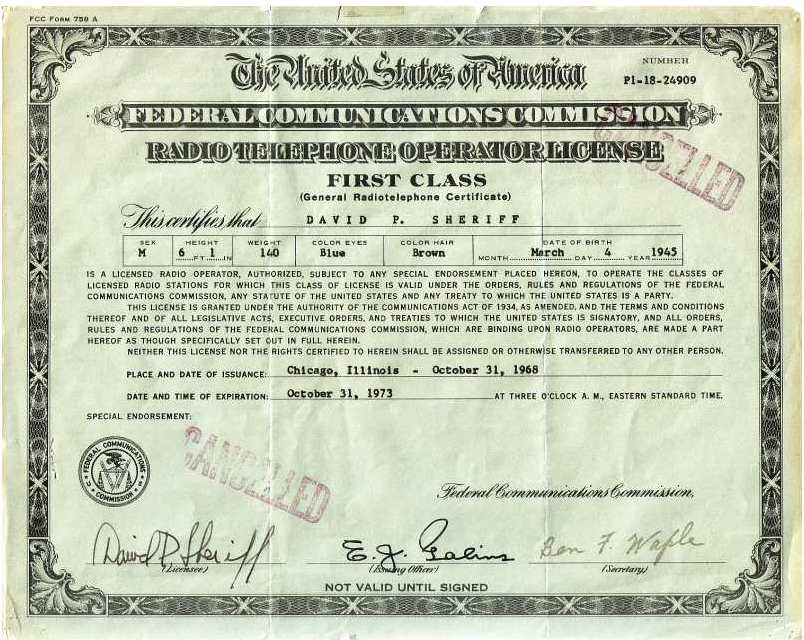
finally found my old FCC First Class License. I needed the legal authority
and certification of expertise the license conferred to run the radio
station and work in When I got it, though, The First Class License was still a mark of significant technical expertise. 1950's era vacuum tube transmitting equipment broke down periodically. There was no time to consult a manual. If the station was dead for more than a short time you lost your audience. Vacuum tube equipment also needed preventative maintenance and testing to ensure the station's emissions met FCC technical standards. There isn't much servicing with today's electronics. If it quits you swap it out. As it dates from 1968 and is marked "expired," this document is my original First class license. They were good for five years and I renewed it at least once. The Second class license is dated September 19. The first class October 31. So I basically just two-stepped the process. The second class ticket was the fastest way to qualify for the WAUK job. Once I had the job, I picked up the First.
I still have my honorable withdrawal card from Local 715, but I don't think I'll be needing it. During
1966 - 1967, on a break before my Junior year, I co-edited the Collegiate Press Service
in Washington, D.C. FORMAL EDUCATION
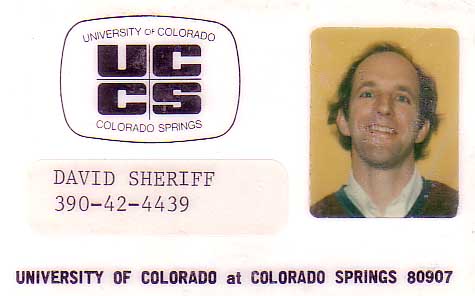
University of Colorado, Colorado Springs, Colorado
One
year of study in engineering, 1983 - 1984.
Valparaiso University and the University of Wisconsin.
Majored in chemistry and history 1963 - 1968.
No degree, but I learned a lot. |